ServicesPool Repair
Pool Repair in Gold Canyon
When your pump hums but won't start, a valve sticks or the heater quits, we find the cause and fix it. We repair the part that failed and point out what is wearing nearby, so your equipment keeps running for years instead of months.
Fix the Part, Keep the System
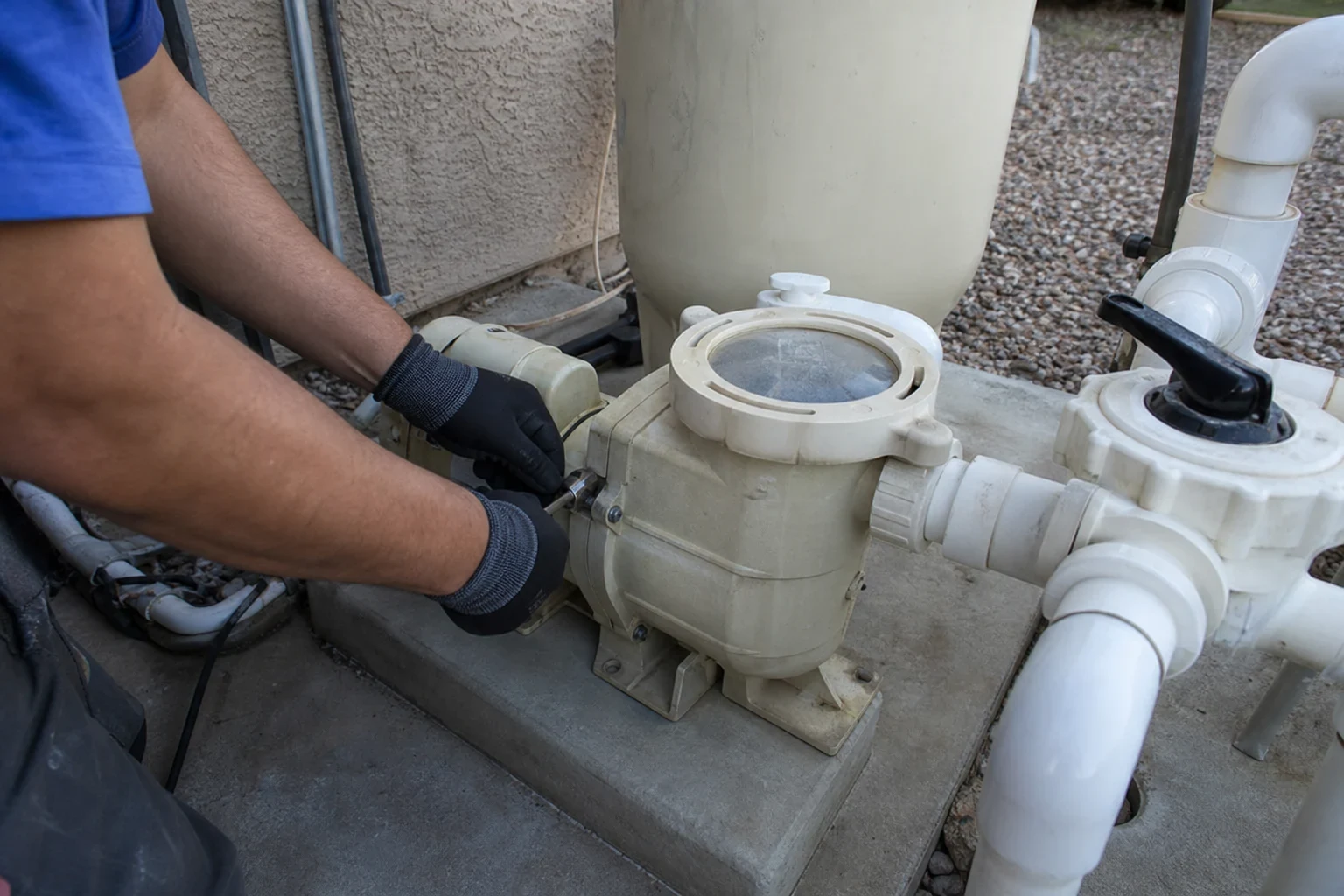
Most pool equipment does not need to be replaced when something goes wrong. A pump that screeches usually needs bearings or a motor. A pump that won't prime often has a cracked lid O-ring or a loose union. These are small fixes, and they keep the rest of the system in service.
We look at the whole pad while we're there. A worn shaft seal left alone drips water onto the motor and ruins it. Catching that early is cheaper than buying a new pump. Our job is to tell you plainly whether a repair makes sense or whether the part is near the end of its life. If replacement is the better call, our Equipment Installation page covers how that works.
What Our Pool Repair Covers
- 01
Pumps and motors
Bearings, shaft seals, capacitors, impellers and full motor swaps. We also clear clogged impellers, which cause more weak flow than people think.
- 02
Filters and housings
Cracked tanks, broken lids, stuck multiport valves, worn O-rings and damaged grids or cartridges. Regular Filter Cleaning keeps a lot of these problems away.
- 03
Heaters
Ignition faults, pressure switches, sensors and scale buildup inside the heat exchanger. We check gas and flow before we condemn a heater.
- 04
Valves and pad plumbing
Diverter valves that stick or leak at the stem, cracked fittings, and unions that weep. Sun-baked PVC gets brittle, so we check the pipe around anything we touch.
- 05
Timers, controls and lights
Mechanical timers, automation controls and pool lights that flicker or go dark. We test the circuit before swapping parts.
Questions about Pool Repair?
Call(480) 534-9618Signs Your Pool Needs a Repair
New noises at the pad
Grinding, screeching or a loud hum usually means bearings or a failing capacitor. Shut it off and have it checked before the motor burns up.
Weak flow at the returns
If the jets push less water than they used to, the cause can be a clogged impeller, a dirty filter or air getting into the line.
Air bubbles or a pump that won't prime
Air in the pump basket points to a bad lid O-ring, a cracked fitting or a valve leaking on the suction side.
Water under the pump
A drip near the motor end is often the shaft seal. It is a cheap part, but ignoring it can cost you the motor.
Filter pressure that won't settle
High pressure right after cleaning, or a gauge that jumps around, can mean a damaged grid, a stuck valve or a bad gauge.
A heater that won't fire
Clicking with no flame, or an error code that keeps coming back, needs a proper diagnosis rather than a reset.
How a Repair Visit Goes
- 1
You call and describe it
Tell us what you hear, see or smell at the equipment. That helps us bring the likely parts on the first trip.
- 2
We diagnose at the pad
We test the equipment, find the cause and look over the parts around it. You get a plain answer on what failed and why.
- 3
You approve the price first
We explain the repair and the cost before any work starts. If something else is wearing, we tell you, and it's your call whether to fix it now or later.
- 4
We fix it and test it
We make the repair, run the system, check pressure and flow, and clean up the work area before we leave.
What Moves the Cost of a Repair
Repair prices depend on the part, the labor and what we find once things are opened up. We give you the price before we start, so there are no surprises on the bill. We also offer a discount to veterans and first responders.
- The part itself
- An O-ring or capacitor costs little. A motor, heat exchanger or control board costs much more.
- Age of the equipment
- Older models can have parts that are harder to find. Sometimes that tips the decision toward replacement.
- Plumbing condition
- If the pipe around a valve or pump is brittle, it may need to be cut back and replaced so the repair holds.
- Access at the pad
- Tight spaces, buried lines or equipment crowded against a wall take more time to work on.
Pool Repair Questions
Should I repair my pump or replace it?
It depends on the age of the pump and what failed. A seal, bearing or capacitor is usually worth fixing. If the motor is shot on an old single-speed pump, a new variable-speed pump may make more sense. We lay out both options and let you decide.
Can I keep running the pump if it's making noise?
We'd advise against it. Bad bearings get worse fast and can overheat the motor. Turn it off and give us a call so we can look at it.
Do you fix equipment you didn't install?
Yes. We work on the common brands of pumps, filters, heaters and valves no matter who put them in.
Will you try to sell me new equipment?
No. If a repair will give you good years of service, that's what we recommend. We only suggest replacement when the repair costs too much for what's left in the part.
Do you serve towns outside Gold Canyon?
Yes. We also work in Apache Junction, Queen Creek, San Tan Valley and other nearby towns. Our Service Areas page has the full list.
Get Your Equipment Running Right
Tell us what's going on at the pad and we'll talk you through the likely fix. You get a clear price before any work starts.